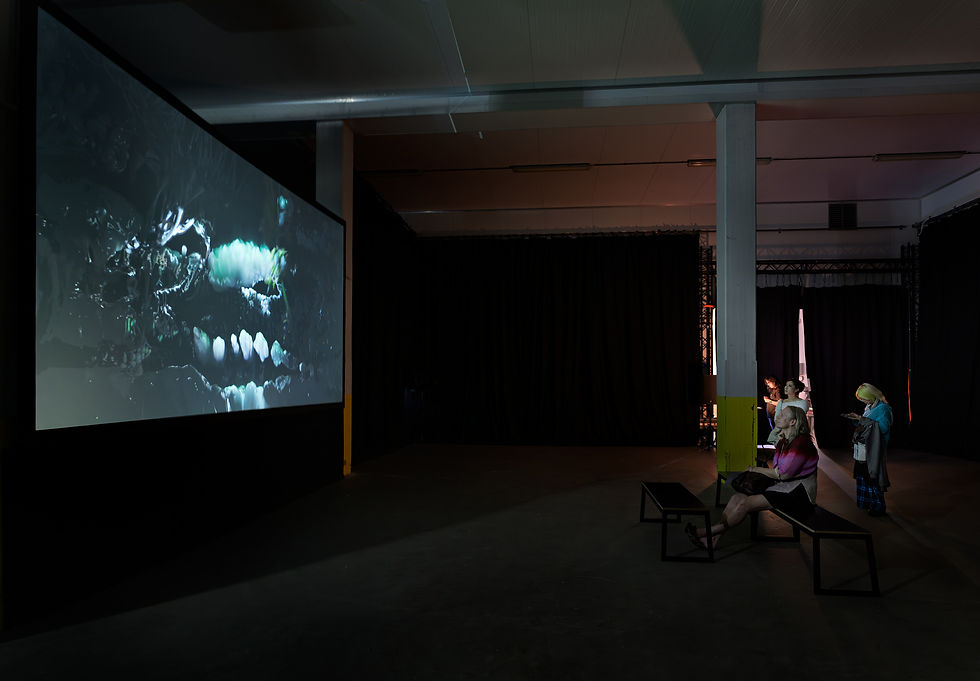
State of Latitude by Khrystyna Kirik
State of Latitude (2024) is an audiovisual installation that reflects on the war’s silent impact on Ukraine’s landscapes. Built in four chapters, it listens to places where biodiversity once flourished and now faces occupation, pressure or irreversible damage.
Fragmented voice and textures intertwine with archival images and ecological records, turning data into sound and vision that shift between documentation and dream. The work asks how destruction becomes part of the environment’s fragile continuity. Rather than offering resolution, the piece opens space for sensing the vulnerability of nature and the urgency of collective care.
State of Latitude is a four-chapter audiovisual installation by Ukrainian artist Khrystyna Kirik, created in collaboration with u2203 studio. Developed during the ∄’s Echoes of the Earth residency in Kyiv, this work serves as environmental testimony, documenting the devastating impact of Russia’s attacks on Ukraine’s southern and eastern landscapes.
The installation explores four distinct ecological environments, each representing a unique aspect of vulnerability and destruction:
Sviati Hory in the Donetsk Region: Chalk fields of pure white now scarred by fortifications and bunkers, where invasive species have displaced unique native vegetation, creating uniform landscapes that have lost their natural uniqueness.
Sivash Island in the Kherson Region: Here, natural fires give life to rare species and bring tulips into massive bloom. This paradox — beauty born from burning — turns the landscape into a painful metaphor of war: red fields rising after fire, life persisting where destruction has passed. Now this land lies in occupation.
Velykyi Chapelsky Pod in the Kherson Region: a vast bowl-shaped depression, approximately 4 by 6 kilometers in size, that serves as a biodiversity hotspot. It is home to unique species found nowhere else in the world, but this ecosystem is now under double threat — from agricultural expansion and from remaining under occupation within the Askania-Nova Biosphere Reserve.
Kamianska Sich in the Kherson Region: This petrophytic steppe, covering an area of 12 261 hectares, has been scarred by mining and shelling. Deep craters cut through its loose soil, wildlife has been lost, and the earth itself remains poisoned by heavy metals that stay long after the explosion.
The composition builds on fragmented, processed voice, weaving in the traditional Ukrainian song ‘Ой, Боже, Боже, з такою годиною…’ from the 1996 Hilka collective’s Songs of the Ukrainian Steppes II. Once sung freely across the steppe, this melody now returns as a haunting echo, woven with electronic textures and environmental sounds — a reflection of how both the land and its voices have been transformed.
Developed by Myk Rudik from u2203 studio led by Alen Hast, the visual layer grows from real artefacts — archival photographs and ecological data collected in the field — and transforms them into shifting, dreamlike landscapes. These images carry the weight of documentation while dissolving into metaphor: fragile terrains that flicker between evidence and memory, destruction and renewal, silence and bloom.
State of Latitude reveals the magnitude and wide scale of destruction while addressing the defenselessness of natural landscapes against aggressive intervention. The work connects this devastation to the broader history of traumatized and exploited lands, emphasizing the urgent need for expansive thinking and cooperation to restore and protect the environment.
All ecological data was collected through interviews with ecologist Anna Kuzemko (Institute of Botany, National Academy of Sciences of Ukraine) about her expeditions to these regions in 2022–2024, including field journals, photographs, and species records.
Khrystyna Kirik is a Ukrainian artist and experimental musician from Kyiv specializing in improvisational and performative audio work. She uses voice, found-object instruments, field recordings and electronics to create focused listening experiences. Her work explores sound as a way to sharpen perception and connect with the environment.